Posts mit dem Label triassic critters werden angezeigt. Alle Posts anzeigen

Montag, 9. Juli 2012

Insect-plant interaction in the Madygen forest

Philippe Moisan, who defended his Ph.D. thesis on floral remains from the Madygen Formation earlier this year, is main author of a recently published paper on ovipostion damage:

Moisan, P., C. C. Labandeira, N. A. Matushkina, T. Wappler, S. Voigt, and H. Kerp (2012): Lycopsid–arthropod associations and odonatopteran oviposition on Triassic herbaceous Isoetites. Palaeogeography, Palaeoclimatology, Palaeoecology 344–345: 6–15. [Link to abstract]

Describes an oviposition damage pattern typical for dragonflies on the quillwort Isoetites which is an unusual thing because lycopsids were not yet known to be hosts of dragonfly egg-laying.

Dienstag, 27. März 2012

The Longisquama paper in press got some media coverage

Science writer Jeff Hecht wrote an article discussing results of our study:

Jeff Hecht: Reptile grew feather-like structures before dinosaurs. New Scientist, issue 2857, 23 March 2012.

Was a bit afraid of this, because often a finely nuanced statement is cited incorrectly or even turned into the opposite when the message of a paper is adapted for a non-specialist audience. Looks okay, though.

Sonntag, 4. März 2012

New papers on Kyrgyzsaurus, Madygenerpeton, and Longisquama

Alifanov, V. R. and E. N. Kurochkin. 2011..Kyrgyzsaurus bukhanchenkoi gen. et sp. nov., a new reptile from the Triassic of southwestern Kyrgyzstan. Paleontological Journal 45(6):639-647.
[DOI: 10.1134/S0031030111060025] [link]

Description of a reptile fossil with skin preservation discovered in 2006. Comes form the same locality as Sharovipteryx and Longisquama. The authors interpret the specimen as a member of drepanosaurs, a Late Triassic group of archosauromorphs. This paper represents one of the last contributions of the Russian palaeornithologist Evgenii N. Kurochkin who passed away recently.

Buchwitz, M., C. Foth, I. Kogan, and S. Voigt. 2012 in press. On the use of osteoderm features in a phylogenetic approach on the internal relationships of the Chroniosuchia (Tetrapoda: Reptiliomorpha). Palaeontology. [DOI: 10.1111/j.1475-4983.2012.01137.x] [link]

Includes a graphic reconstruction of Madygenerpeton (drawing by Frederik Spindler).

Buchwitz, M. and S. Voigt. 2012 in press. The dorsal appendages of the Triassic reptile Longisquama insignis: reconsideration of a controversial integument type. Paläontologische Zeitschrift.
[DOI: 10.1007/s12542-012-0135-3] [Link]

More thorough description/ graphic documentation compared to Voigt et al.(2009) and considers some aspects of diapsid skin evolution.

Samstag, 10. September 2011

Madygen freshwater sharks made the JVP front page

Fischer, J., S. Voigt, J. W. Schneider, M. Buchwitz & S. Voigt (2011): A selachian freshwater fauna from the Triassic of Kyrgyzstan and its implication for Mesozoic shark nurseries. Journal of Vertebrate Paleontology 31: 937- 953. [Abstract]

Aha: Egg capsules and microvertebrate fossils can be a worthwile study object after all. (Event though Jan Fischer, my fellow grad student at the Geological Institute in Freiberg, had an interview with a critical local newsreporter who doubted that anybody could ever be interested in something like that.)

Jan and colleagues describe chondrichthyan egg capsule fossils from the Madygen Formation and refer them to Palaeoxyris, a capsule type usually assigned to hybodont sharks, and Fayolia, probably produced by xenacanth sharks. These fossils are accompagnied by nearby finds teeth of hybodont shark teeth - most of them are tiny and probably belonged to juveniles of the newly erected species Lonchidion ferganensis.

Oxygen isotope analysis of the teeth and their comparison to hybodont teeth from other localities yields a clear freshwater signal for the Madygen samples, indicating that the shark offspring indeed inhabited a freshwater habitat.

Facial analysis of the sedimentary succession of the Madygen Formation demonstrates the presence of wide-spread shallow and vegetated shore areas during the Middle Triassic which could have functioned as a shark nursery, i.e. a separate and ecologically distinct habitat for juveniles which was not invaded by adult sharks of the same species.

Dienstag, 10. Mai 2011

Triassic cicadomorph insects with camouflage

Shcherbakov, D. 2011. New and little-known families of Hemiptera Cicadomorpha from the Triassic of Central Asia – early analogs of treehoppers and planthoppers. Zootaxa 2836: 1-26. [article preview with abstract]

Dmitry Shcherbakov describes twelve new (monotypic) genera and species of cicadomorphs from the Madygen Formation on the basis of some exquisitely preserved fossils and redescribes three others.

He finds homoplastic similarities of the fossil families Saaloscytinidae and Maguviopseidae (newly erected) to leaf hoppers and tree hoppers (Membracoidea) and of Mesojabloniidae to plant hoppers (Fulgoroidea)

Convergent to the extant groups of cicadomorphs the newly described fossil taxa use different means of camouflage, namely bizarrely-shaped tegmina (singular 'tegmen' = anterior cover wings without aerodynamic function), dorsal projections on the thorax and tegmen, well-developed surface sculpture, and (dull) coloration. According to Shcherbakov the specific morphology of the Maguviopseidae and Saaloscytinidae mimicked thorns, bracts, seed-bearing organs, seeds, buds, or leaves, whereas the Mesojabloniidae mimicked rotten wood or bark.

Shcherbakov assumes that predation by tree-living reptiles, such as Sharovipteryx and Longisquama (which are known from the same locality within the Madygen Formation), was an important factor underlying the evolution of elaborate types of camouflage.

As none of these Triassic hoppers appear to have survived for long, Shcherbakov concludes that their extinction was linked to the extinction of the host plants whose plant organs they imitated.

Sonntag, 10. April 2011

A palaeodictyopteran and other relics from Madygen

Béthoux, O., S. Voigt, and J. W. Schneider. 2010. A Triassic palaeodictyopteran from Kyrgyzstan. Palaeodiversity 3: 9-13. [pdf 1.5 Mb]

Despite the substantial collection and study of insect fossils from the Madygen Formation (see overview in Shcherbakov 2008a) there are still unkown elements of the entomofauna left. Béthoux et al. (2010) describe a wing of a not yet reported group of insects from lacustrine shales of the northwestern ouctrop area of the Madygen Fm. (which also yielded Sharovipteryx and Longisquama).

Ruling out all alternatives on the basis of wing venation data, they come to the conclusion that reliquia spec. nov. was a late member of Palaeodictyoptera, an order-rank group according to conventional classification schemes that was previously thought to have died out during the Middle or Late Permian.

Béthoux et al. suggest that the disappearance of ancient insect groups in equatorial realms is linked to the Late Paleozoic aridisation in these areas that triggered the migration to wetter higher latitude ecosystems, such as the Madygen lake environment. The relatively late occurence of paleodictyopterans in Madygen is also in agreement with Shcherbakov's (2008b) hypothesis that the renewal of Triassic entomofaunas was asynchronous, starting in the lower latitudes and spreading to the higher latitudes.

Other Madygen relics?

Apart from modern groups, such as dipterans and hymenopterans among insects as wells as lissamphibians and archosaurs among tetrapods there are further relict forms, such as the choniosuchian Madygenerpeton or the basal cynodont Madysaurus. As hinted by Béthoux et al. the question to what degree and why Madygen functioned as a refugium is still to be answered.

Mittwoch, 30. März 2011

Chroniosuchia: Paper on osteoderm histology in online preview

...my first experience with bone histology:

Buchwitz, M., Witzmann, F., Voigt, S. & Golubev, V. in press. Osteoderm microstructure indicates the presence of a crocodylian-like trunk bracing system in a group of armoured basal tetrapods. Acta Zoologica, DOI: 10.1111/j.1463-6395.2011.00502.x

Abstract. The microstructure of dorsal osteoderms referred to the chroniosuchid taxa Chroniosuchus, Chroniosaurus, Madygenerpeton and cf. Uralerpeton is compared to existing data on the bystrowianid chroniosuchian Bystrowiella and further tetrapods. Chroniosuchid osteoderms are marked by thin internal and relatively thick external cortices that consist of lowly vascularised parallel-fibred bone. They are structured by growth marks and, in case of Madygenerpeton, by lines of arrested growth. The cancellous middle region is marked by a high degree of remodelling and a primary bone matrix of parallel-fibred bone that may include domains of interwoven structural fibres. Whereas the convergence of Bystrowiella and chroniosuchid osteoderms is not confirmed by our observations, the internal cortex of the latter displays a significant peculiarity: It contains distinct bundles of shallowly dipping Sharpey’s fibres with a cranio- or caudoventral orientation. We interpret this feature as indicative for the attachment of epaxial muscles which spanned several vertebral segments between the medioventral surface of the osteoderms and the transversal processes of the thoracic vertebrae. This finding endorses the hypothesis that the chroniosuchid osteoderm series was part of a crocodylian-like trunk bracing system that supported terrestrial locomotion. According to the measured range of osteoderm bone compactness, some chroniosuchian species may have had a more aquatic lifestyle than others.

Sonntag, 16. Januar 2011

New paper on cycadophytes from Madygen

Moisan, P., S. Voigt, C. Pott, M. Buchwitz, J. Schneider, and H. Kerp. in press. Cycadalean and bennettitalean foliage from the Triassic Madygen Lagerstätte (SW Kyrgyzstan, Central Asia). Review of Palaeobotany and Palynology. [DOI:10.1016/j.revpalbo.2010.11.008]

Philippe Moisan who is doing his Ph.D. in Münster (with paleobotanist Hans Kerp as his supervisor) studies the flora of the Triassic Madygen Fm. In his first paper on that issue he introduces cycadophyte finds collected between 2005 and 2009.

Many of the studied the specimen come from the same succession and locality as Madygenerpeton (there is also a small sketch of the sedimentary profile, see Fig. 2).

One thing I learned from this study was that so-called "xeromorphic features", i.e. plant features that are usually the consequence of an adaptation to aridity, cannot only occur in xerophytes, i.e. in plants adapted to dry environments, but (for other reasons) in hygrophytic and halophytic plants as well.

Indications for aridity, such as desiccation crack horizons or or seasonally drying-out ponds and rivers or wide-spread red bed sediments are lacking in Madygen. Thus, according to Philippe's interpretation, "xeromorphism" in Madygen plants probably served other purposes than the xeromorphism of xerophytes (e.g. "self-cleaning of the leaf surface, regulation of excessive radiation and leaf temperature, mechanical defense against phytophagous insects").

Donnerstag, 2. Dezember 2010

Three recent papers on chroniosuchians

Buchwitz M, Voigt S. 2010. Peculiar carapace structure of a Triassic chroniosuchian implies evolutionary shift in trunk flexibility. Journal of Vertebrate Paleontology 30: 1697-1708. [Link]

Schoch RR, Voigt S, Buchwitz M. 2010. A chroniosuchid from the Triassic of Kyrgyzstan and analysis of chroniosuchian relationships. Zoological Journal of the Linnaean Society 160: 515-530. [Link]

Klembara J, Clack J, Čerňanský A. 2010. The anatomy of palate of Chroniosaurus dongusensis (Chroniosuchia, Chroniosuchidae) from the Upper Permian of Russia. Palaeontology 53: 1147-1153. [Link]

The redescription of the Chroniosaurus dongusensis palate by Klembara and colleagues adds further data to the morphological dataset provided by Clack and Klembara (2009) in their revision of C. dongusensis on the basis of a new specimen (which is the most complete of any yet known chroniosuchian). According to the updated phylogenetic analysis from the 2010 paper Chroniosaurus as the only included chroniosuchian taxon formed the sister group of embolomeres.

Schoch and colleagues (me included) describe Madygenerpeton pustulatus, a new species of chroniosuchians from the Middle to Late Triassic of Central Asia with a highly derived skull morphology and a carapace that was chroniosuchid-like in many aspects. The find shows that one lineage of chroniosuchids survived the Permian-Triassic boundary (by 20 or so million years).

The authors discuss characteristics uniting chroniosuchians with "higher reptiliomorphs" and unlike the approach of Klembara and colleagues their cladistic analysis, which includes five chroniosuchian taxa, results in a position of chroniosuchians somewhat closer to amniotes than to embolomeres. Chroniosaurus comes out as the closest relative of Madygenerpeton (both share the characteristic ornamentation of the skull and osteoderms besides other features).

Buchwitz & Voigt consider the functionality of chroniosuchian carapaces, comparing them to archosaur osteoderm systems. They argue that chroniosuchian carapaces basically served terrestrial locomotion but that the higher lateral flexibility of the Madygenerpeton osteoderm system was linked to a secondary increase in undulation swimming capability.

Reference:
Clack JA, Klembara J. 2009. An articulated specimen of Chroniosaurus dongusensis, and the morphology and relationships of the chroniosuchids. Special Papers in Palaeontology 81: 15-42. [Link]

Donnerstag, 28. Oktober 2010

Madygenerpeton pustulatus: first description finally out

Schoch, R. R., S. Voigt, and M. Buchwitz. 2010. A chroniosuchid from the Triassic of Kyrgyzstan and analysis of chroniosuchian relationships. Zoological Journal of the Linnean Society 160(3): 515-530. [Abstract]

Montag, 22. März 2010

Madygen trace fossil paper

Voigt, S. and D. Hoppe. 2010. Mass Occurrence of Penetrative Trace Fossils in Triassic Lake Deposits (Kyrgyzstan, Central Asia). Ichnos 17:1-11. [Link]

Besides the exquisite soft body preservation of insects and tetrapods within some parts of the lacustrine succession, the Triassic Madygen lake shows a rich inventary of invertebrate trace fossils, studied by my colleague from Freiberg Sebastian Voigt.

The interesting point about these ichnofossil assemblages is that they demonstrate a certain differentiation of the lake ground in better and less well aerated zones, displaying different degrees of bioturbation and abundances of indicative ichnotaxa.

You can imagine that fresh water lake grounds only became inhabited stepwise after the conquest of land by animals, so these trace fossil assemblages mark a certain evolutionary level of lake ecosystems, otherwise rarely documented in detail from the Middle to Late Triassic.

Samstag, 17. Oktober 2009

Madygen News 2009

Expedition. This year's two month expedition to Madygen, Kyrgyzstan, ends in about a week. Rather than merely assembling more fossils the task for 2009 was to carry out further observations concerning the facies architecture and fine stratigraphy of the Madygen Formation - in fact to solve the evolution of the Madygen depositional environment throughout the time comprised by the Triassic sequence of the Madygen SW outcrop area.

Since the ways of communication between Germany and the Kyrgyz outback are difficult I didn't get much of an opportunity yet to talk to Madygen project leader Sebastian Voigt (my de facto chief who is still in the field). But from what I've heard the paleoenvironment is now well explained and some furthergoing approaches, e.g. comparing the conditions of Madygen to those of the other (few) terrestrial lagerstätten of the Triassic, are now feasible.

Symposia contributions and papers

- on the flora:

Moisan, P., H. Kerp, S. Voigt, C. Pott & M. Buchwitz (2009): Cycadophyte foliage from the Triassic Madygen Formation, SW Kyrgyzstan Central Asia. Terra Nova 2009/3:81-82. [Abstract Volume of Annual Meeting of the German Paleontological Society in Bonn] ... the respective paper is soon to come.

- on kazacharthran body and trace fossils: ... still in the review process.

- on fish:

Kogan, I., K. Schönberger, J. Fischer, S. Voigt & M. Buchwitz (2009): A nearly complete Saurichthys specimen from the Triassic of Madygen (Kyrgyzstan, Central Asia). Terra Nova 2009/3: 63-64.

A first note on this find will published at the end of 2009 in Freiberger Forschungshefte.

SVP poster on egg capsules and teeth of hybodont sharks, which have been discovered in 2008: Fischer, J., S. Voigt, M. Buchwitz & J.W. Schneider (2009): The selachian fauna from the non-marine Middle to Late Triassic Madygen Formation (Kyrgyzstan, Middle Asia): preliminary results. JVP 29 (3, suppl.): 95A-96A.

- on chroniosuchians:

Buchwitz, M. & S. Voigt (2009): Locomotion aspects of a chroniosuchid carapace. In: D. Schwarz-Wings, O. Wings & F. Sattler (eds.): 7th Annual Meeting of the European Association of Vertebrate Paleontologis - Abstract Volume. Aachen, 2009, p.14.

Buchwitz, M. & S. Voigt (2009): Phylogenetic and functional implications of the chroniosuchian osteoderm morphology. Terra Nova 2009/3: 25.

I'm trying hard to finish these manuscripts just now. The first description of the new chroniosuchid species, focussing on the skull features, is 'in press'.

- about the thing that must not be named:

Buchwitz, M., S. Voigt & J. Fischer (2009): Dorsal appendages of You-know-what reconsidered: aspects of development and the link to the evolution of filamentous integumentary structures. JVP 29 (3, suppl.): 72A.

...there is another longer manuscript putting some effort into the detailed description/documentation and a discussion of some rather modest model (... but I cannot really tell yet whether an 'accept' is feasible in the near future).

- on the depositional environment of the Lagerstätte Madygen and its tetrapod localities:

Voigt, S., M. Buchwitz, J. Fischer, P. Moisan & I. Kogan (2009): Lagerstätte Madygen - outstanding window to a continental Triassic ecosystem. JVP 29 (3, suppl.): 196A.

Buchwitz, M., S. Voigt, J. Hentschke & P. Moisan (2009): The Triassic Madygen Formation (Kyrgyzstan, Middle Asia) features a new tetrapod locality. Terra Nova 2009/3: 25-26.

...the latter poster introduces some (real) archosaur finds from 2008.

Sonntag, 28. Juni 2009

Chroniosuchians and stay in Moscow

To resolve the riddle: The bonified eyeball from the last post represents a a ball-shaped intercentrum of a chroniosuchid from the Permian of Russia.

In chroniosuchian reptiliomorphs the intercentra (white arrows) are interlocked with the amphicoelous pleurocentra in a ball-and-socket-like fashion. The image on the left shows some section of a Chroniosuchus vertebral column in ventral view. Intercentra become bony balls only in the adult individuals - not fully bonified in sub-adults and juveniles they are preserved with a crescent, disk-like or ellipsoidal shape.

Also, the fusion of the neural arch with the pleurocentrum - a feature otherwise characteristic for "higher reptiliomorphs" such as seymouriamorphs and diadectomorphs - is only completed in the course of ontogenesis (so that you can find suture lines in the subadult individuals).

Moscow: Paleontological Institute and Museum of the Russian Academy of Sciences (PIN)

The paleo-style PIN building has a castle-like rectangular shape with an inner courtyard featuring life-size sculptures of fossil critters from Russia and areas of the former Soviet Union. The exhibition has almost everything you wish for as a vertebrate enthusiast (here depicted: the two-story dinosaur hall). Rich in type specimens the collection is essential for some and important for many studies - so earlier or later many of the fossil vertebrate people spend some time there.

Concering the Chroniosuchia: With the exception of bystrowianid chroniosuchian remains from Kupferzell, Germany (Witzmann et al. 2008) and China (Young 1979) and some rather questionable Chinese chroniosuchid chroniosuchians (Li & Cheng 1999), all yet described Permian and Triassic chroniosuchian taxa come from the European part of Russia and are mostly archived in the PIN. I am thankful to Valery Golubev who helped me a lot during my week of stay when I was studying the type materials and to Jury Gubin who nicely put up with me in his room.

Some literature on chroniosuchians

Here considered: titles also available in English (plus the Chinese ones mentioned above).

Golubev, V. K. (1998).
"Narrow-armored Chroniosuchians (Amphibia, Anthracosauromorpha) from the Late Permian of Eastern Europe." Paleontologicheskij Zhurnal 1998(3): 64- 73. [Russian, English]

Golubev, V. K. (1998). "Revision of the Late Permian chroniosuchians (Amphibia, Anthracosauromorpha) from Eastern Europe." Paleontologicheskij Zhurnal 1998(4): 68- 77. [Russian, English]

Golubev, V. K. (1999).
"A new narrow-armored chroniosuchian (Amphibia, Anthracosauromorpha) from the Late Permian of the East Europe." Paleontologicheskij Zhurnal 1999(2): 43- 50. [Russian, English]

Li, J., Cheng Z. (1999). " New anthracosaur and temnospondyl amphibians from Gansu, China." Vertebrata PalAsiatica 37(3): 234- 247. [Chinese with English abstract]

Novikov, I. V., M.A. Shishkin (2000). "Triassic chroniosuchians (Amphibia, Anthracosauromorpha) and the evolution of the trunk dermal ossifications in the bystrowianids." Paleontological Journal 34(supplement): S165- S178. [English]

Novikov, I. V., M.A. Shishkin, V.K. Golubev (2000). Permian and Triassic anthracosaurs from Eastern Europe. The Age of Dinosaurs in Russia and Mongolia. M. A. S. M.J. Benton, D.M. Unwin, E.N. Kurochkin. Cambridge, Cambridge University Press: 60- 70. [English]

Witzmann, F., R.R. Schoch, M.W. Maisch (2008). "A relic basal tetrapod from the Middle Triassic of Germany." Naturwissenschaften 95(1): 67- 72. [English]

Young, C. C. (1979). "A new Late Permian fauna from Jiyuan, Honan." Vertebrata Palasiatica 17: 99- 113. [Chinese with English abstract]

Donnerstag, 14. Mai 2009

PALHERP Bonn 2009

The Meeting of the German Paleoherpetologists was launched in 1997 as an act of rebellion against the old mammal establishment which ruled the regular vertebrate workshops of the German Paleontological Society. A particular aspect of the Palherp is the relaxed atmosphere giving students the chance to present ideas and results without unfair senior criticism.

Last weekend the 13th Palherp meeting was held in Bonn. As the Steinmann Institute of Bonn University houses the German Research Foundation Unit on Sauropod Biology you can call it one of centres of paleoherpetology in Germany. Given the focus of the Bonn working group many of this year's presentations covered dinosaurs and/or bone histology.

Saturday: Martin Sander's keynote lecture on sauropod biology was followed by presentations on sauropodlet longbone histology, on rib histology and sauropod reproduction strategies.

The lower tetrapod session covered chroniosuchians, a pelycosaur jaw fragment as the earliest German amniote find, parareptiles and a basal diapsid.

In the afternoon a presentation on didactyle theropod footprints from the Oberkirchen Sandstone and a discussion of arguments/ phylogenetic analyses in favour of convergent flight origins in the Eumaniraptora followed. Furthermore a talk on finds from the Lower Muschelkalk of Winterwijk. H. Haubold discussed problems related to the continental P/T mass extinction event if it is taken as a dogma.

Sunday talks included the introduction of a new basal sauropod (from Niger), dinosaur palaeopathology, tooth morphology, isotope palaeontology, and 19th century history of dinosaur science.

Freitag, 13. Februar 2009

Permotriassic entomofaunal change + the Madygen

Dmitry E. Shcherbakov from Moscow is one of the paleobiologists studying the very group of beings for which Madygen really is a lagerstätte: insects.

Some of his 2008 papers in the Moscovian Paleontological Journal and Alavesia, a relatively new journal for fossil insects, can be found as .pdfs on the library page of the International Palaeoentomological Society (IPS).


Shcherbakov, D.E. 2008. Insect recovery after the Permian/Triassic crisis. Alavesia 2: 125-131. [pdf]

Shcherbakov, D.E. 2008. On Permian and Triassic insect faunas in relation to biogeography and the Permian–Triassic crisis. Paleontological Journal 42 (1): 15-31. [pdf]

The Alavesia paper outlines a three phase development of Triassic entomofaunas, beginning with
(I) a low-diversity episod of P/T recovery dominated by Paleozoic insect groups, followed by
(II) a summit phase with typical Triassic taxa in the Anisian-Carnian, and, with a decline in diversity, ending in
(III) a phase dominated by Late Mesozoic elements, especially featuring new aquatic insect groups.
Shcherbakov suggests, that each of the transitions began in the humid low latitudes and occurred later in the higher latitudes, i.e. the boundaries between those three stages are diachronous.

In the Paleontological Journal paper Dmitry Shcherbakov looks at the insect diversity of Late Carboniferous to Triassic localities, counting the proven occurrences of insect families per stage ('stage' as a chronostratigraphic unit). He illustrates the change in aquatic/ terrestrial, phytophages/ predators, modern/ ancient groups and explains the ecological, evolutionary, and biogeographic background of diversity fluctuations.


Shcherbakov, D.E. 2008. Madygen, Triassic Lagerstätte number one, before and after Sharov. Alavesia 2: 113-124.[pdf]

This review paper begins with a recount of the research history of the Madygen Formation as a Triassic fossil locality, beginning with the geological fieldwork in the 1930s (by Kochnev) which led to the first finds of a fossil flora, classified as Triassic, and to the introduction of the Madygen strata as a separate stratigraphic unit.

In detail the role of paleoentomologist Alexander G. Sharov is recognized, who lead five field expeditions between 1962 and 1966 to a fossiliferous point in the northern Madygen outcrop area (Dzhailoucho). These campaigns turned out as the most successful with regard to the number of recovered insect specimens and other fossils. The historical part is followed by a short overview of the flora and non-insect fauna.

The main part is a synopsis of the particular insect fauna of Madygen. Besides the exquisite state of preservation, several figures illustrate why Madygen really is a lagerstätte: Members of twenty insect orders and 96 out of 106 insect families known from the Ladinian/Carnian have been reported from the Madygen Formation.

In this order beetles, cockcroaches, and homopterans represent the most abundant groups. Among rarer groups are certain specialities, such as the most diverse assemblage of titanopterans. Modern insect orders are represented by several groups of early dipterans and the earliest hymenopterans (belonging to the group of sawflies).

Freitag, 23. Januar 2009

Triassic critters: Freshwater sharks

Lakes and rivers of the younger Paleozoic and as well in the Triassic could not only house tetrapod and bony fish vertebrate dwellers but also selachian predators, in particular the Xenacanthida, well known for their characteristic neck spines, and the Hybodontiformes, which display a pair of lateral head spines and characteristic fin spines. The latter are distinct from those of the Acanthodii (popularly also referred to as "spiny sharks"), a group of basal vertebrates that ocurred in freshwater environments as well, but became extinct before the beginning of the Triassic.

Complete shark specimens are seldom recorded, the same is true for complex finds comprising a couple of skeletal elements from the same individual - taxonomists often have to deal with assemblages of individual scales, spines, and teeth and systematics heavily relies on tooth characteristics (e.g. Schneider 1988 for the Xenacanthida, Rees 2008 for hybodont sharks).

Like the recent bullhead sharks (Heterodontus) at least some of the Carboniferous to Triassic freshwater sharks were oviparous - different types of spiral egg capsules not quite unlike those capsules of Heterodontus occur in different types of freshwater environments, e.g. marginal lake sediments or low-energy river banks; often they appear unrelated to skeletal remains. This has been interpreted as being indicative for a separation between the actual habitats of the sharks and their spawning grounds (about the facial aspects: see Schneider & Reichel 1989). To what extent the occurrence of xenacanth and hybodont sharks in freshwater deposits is indicative for a marine influence is currently a matter of debate.

In the first descriptions of the 19th century fossil egg capsules were misinterpreted as cone-like fructifications of some kind of plant. This was due to the rhomboidal pattern the egg capsule impressions often display as consequence of taphonomic flattening (and the consequent overlap of the spiral patterns on the front and back sides). Two types of shark egg capsules have been recovered from the Madygen Formation during fieldwork in 2007 (Fischer et al. 2007) - more on that later.

-----
Jan Fischer, featured in the last FPhotW, who is working on the Madygen chrondrichthyans (as soon as they appear) and isotope paleontology of shark teeth/spines, is thanked here for supplying me with literature. (Hopefully I can convince Jan to write a guest contribution).

Refs:

Synoptical papers:
Maisey, J.G. (1982): The Anatomy and Interrelationships of Mesozoic Hybodont Sharks. - American Museum Novitates 2724: 1- 48; New York.

Schneider, J. W. & Zajic, J. (1994): [Xenacanths (Pisces, Chondrichthyes) of the middle European Upper Carboniferous and Permian - revision of the originals of GOLDFUSS 1847, BEYRICH 1848, KNER 1867 and FRITSCH 1879-1890.] - Freiberger Forschungshefte, C 452: 101-151; Leipzig.


On tooth systematics:
Schneider, J.W. (1988): [Basics of the morphogeny, taxonomy, and biostratigraphy of isolated xenacanth teeth (Elasmobranchii)]. - Freiberger Forschungshefte, C 419: 71- 80; Leipzig.

Rees (2008): Interrelationships of Mesozoic hybodont sharks as
indicated by dental morphology – preliminary results. - Acta Geologica Polonica 58 (2): 217-221.


On egg capsules:
Schneider, J.W. & Reichel, W. (1989): [Chondrichthyan egg capsules from the Rotliegend (Lower Permian) of Middle Europe - conclusions regarding the palaeobiogeography of palaeozoic freshwater sharks.] - Freiberger Forschungshefte, C 436: 58- 69; Leipzig.

Fischer, J., Voigt, S. & Buchwitz, M. (2007):
First elasmobranch egg capsules from freshwater lake deposits of the Madygen Formation (Middle to Late Triassic, Kyrgyzstan, Central Asia). - Paläontologie, Stratigraphie, Fazies (15), Freiberger Forschungshefte, C 524: 41-46; Freiberg.

Dienstag, 9. Dezember 2008

Madygen: Recent contributions to symposia


12th International Palynological Congress, Bonn 2008:


Philippe Moisan, Hans Kerp, Sebastian Voigt, Benjamin Bomfleur: The fossil flora of the Madygen Formation from the Middle to Upper Triassic, Kyrgyzstan, Central Asia. Terra Nostra 2008/2: 194

Abstract. The Middle to Late Triassic Madygen Formation (Kyrgyzstan, Central Asia) is a unique fossil lagerstaette for Early Mesozoic insect remains and small reptiles with soft-tissue preservation. Plant fossils from these deposits from are known since the 1930s and constitute one of the richest and most diverse Triassic floras of Eurasia. However, they received very little attention to date and their studies have to date been based on macromorphological features only. We present the first record of epidermal features of this diverse Triassic flora based on recently recovered fossil plant material. Many of the Madygen plant fossils show a highly remarkable preservation. Due to its very fine grain-size, the embedding sediment has often formed a natural cast of the epidermal cell pattern. Such epidermal features allow detailed systematic descriptions as well as palaeoecological interpretations. This fossil flora is dominated by pteridosperms, ginkgophytes, and sphenophytes. In addition, algae, mosses, lycophytes and ferns occur and many are new for this fossil flora. The high abundance of fructifications is of particular interest. Another important aspect of the Madygen flora is that many gymnosperm leaves show evidence for plant-insect interactions (e.g. margin feeding, oviposition, mining traces). The supposed Middle to Late Triassic age of the flora coincides with one of the most important herbivore expansions in the fossil record. However, while this phenomenon has been recognised in the Middle and Upper Triassic of the USA, Western Europe, and South Africa, no data are available from coeval Central Asian sequences. The on-going study aims to provide a revised systematic description of the plants, including epidermal features to characterise the palaeoecosystem of the Madygen lagerstaette in more detail, and to contribute to a better understanding of the evolution of plant-animal interactions during the Early Mesozoic.

Ichnia, Cracow 2008:

Voigt, S., Buchwitz, M.: On the Mermia ichnofacies in a Triassic overfilled lake-basin of Southern Fergana (Kyrgyzstan, Central Asia). Ichnia 2008, Cracow (Poland), September 1- 5

Abstract.
Fluvio-lacustrine deposits of the Madygen Formation on the northern rim of the Turkestan Mountains in southwestern Kyrgyzstan are one of the few occurrences of Triassic continental strata in Central Asia. During the 1960s Russian palaeobiologists successfully explored the stratum typicum area of the Madygen Formation for macrofossils, unearthing a remarkably rich Early Mesozoic flora, thousands of insect remains, and unusual reptiles with soft-tissue preservation (Dobruskina, 1995). Considering the number, diversity and preservation of the finds, the locality represents a lagerstaette. Lacking investigations on the geological and palaeoecological background of the findings, however, its particular importance for the evolution of terrestrial ecosystems has not yet been revealed. Thus, a comprehensive approach on the Madygen ecosystem including a detailed facial analysis of the fossil-bearing strata is currently carried out.
The Madygen Formation is an up to 500 m thick series of predominantly siliciclastic rocks, which formed in an intermontane basin under humid to semi-humid climatic conditions. Sedimentary successions are composed of alluvial fan conglomerates, channel sandstones and overbank fines with intercalated coal seams of a highly-vegetated alluvial plain, as well as deltaic sandstones and laminated lacustrine mudstones of basin centre. Shallowing upward sequences and various other features, e.g. dense vegetation, wet soils, and the lack of desiccation cracks, typify the depositional environment of the Madygen Formation as an overfilled lake-basin sensu Bohacs et al. (2000).
Though they were never mentioned in earlier palaeontological reports, trace fossils of the Mermia ichnofacies belong to the most common phenomena of the Madygen fossil assemblage. Networks of tiny, irregularly branched burrows with high bedding-parallel extension are ubiquitous in the laminated mudstones of the lake deposits. Architecture and size of the burrows indicate deposit-feeding, worm-like trace makers such as the extant oligochaetes and aquatic insect larvae. The bioturbation maximum is recorded in mudstones of the transitional sublittoral to profundal lake zone which probably included a chemocline as in some modern stratified lakes. More shallow but clearly submerged parts of the lake were occupied by benthic ostracods and kazacharthra - triopsid-like branchiopods which are thought to be endemic to the Mesozoic of Central Asia (Chen et al., 1996). Body imprints of the kazacharthra occur spatially close to ribbon- and sickle-shaped trace fossils. We are attributing these traces to different types of kazachartran feeding activity: (1) grazing if the ground water layer is well aerated and (2) short-term mud-diving under oxygen-depleted conditions. All ichnia – the shallow penetrative traces and the presumable kazacharthran traces – were produced in the permanently subaquatic environment of a sizeable lake with a minimum length of 1.7 km. The restriction of trace types to a certain ground level relative to the chemocline may yield a basic approach for the subdivision of the Mermia ichnofacies.

German Paleontological Society Meeting, Erlangen 2008:


Voigt, S., Buchwitz, M., Fischer, J., Krause, D.: Longisquama's dorsal skin appendages: new finds from the type locality. Erlanger Geologische Abhandlungen, Sonderband 6: 117

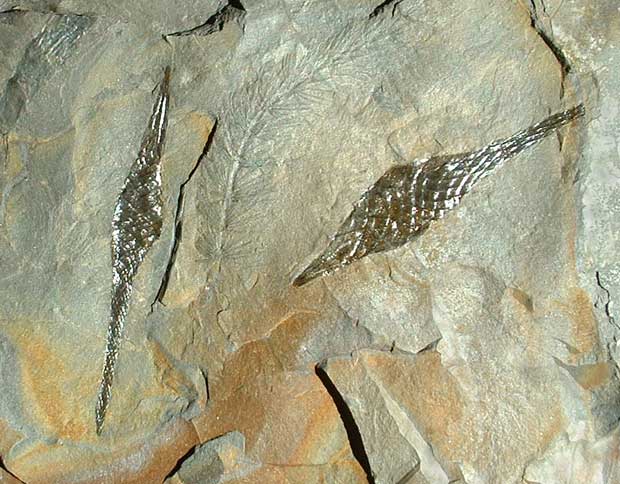
Abstract. During the 1960s Russian palaeobiologists discovered two incomplete diapsid skeletons with skin impressions in lacustrine shales of the Triassic Madygen Formation, a continental sedimentary succession in southwest Kyrgyzstan, Central Asia. Described by A.G. Sharov in 1970 and 1971 the two finds became known for the uniqueness of the species they represent: While Sharovipteryx mirabilis was an early limb-supported reptilian glider with an exceptionally large uropatagium and probably an archosauromorph, Longisquama insignis, whose systematic position is still controversial, displays a series of elongate hockey-stick-shaped skin projections, rooting along the dorsal midline of the body. The appendages are structurally complex and some morphological features, e.g. the presence of a middle axis and the assumed branching, have motivated their comparison with avian feathers. Apart from four Longisquama paratype specimens with isolated skin appendages no further material belonging to one of the two diapsid species has ever been documented.
Here we report three new finds of the Longisquama appendages which have been recovered from the type locality in the northwestern Madygen outcrop area (Urochishche Dzhaylyau-Cho) during fieldwork in 2007: The single exemplar FG 596/V/1 has a length of 28.9 cm, exceeding all other known specimens by at least 100%. Comparable to the appendages of the holotype it comprises a narrow and relatively long proximal section with a tripartite appearance and a relatively short and wide distal section whose two corrugated longitudinal lobes are separated by a prominent middle axis. The apical end and the basal end are not preserved. FG 596/V/2 and FG 596/V/3 represent 3.6 and 3.7 cm long fragments of the distal section. In FG 596/V/1 and FG 596/V/3 the imprints on the left slab and right slab enclose a thin continuous sedimentary core, a feature which has been regarded as indicative for the overall membranous constitution of the appendages.
Especially the very long specimen FG 596/V/1 has some importance for the developmental and functional interpretation of Longisquama’s skin structures: Exceeding the proximal width of other dorsal appendages by only a small amount its length/ basal width ratio is conspicuously high (>50). This can be interpreted as a consequence of uniaxial growth with the constricted proximal and the extended distal section representing two distinct phases of a developmental cycle. Considering the shape and dimensions of FG 596/V/1 we find no easy explanation how the appendages could have formed a closed and stable airfoil, let alone one which produces enough lift to support gliding flight as assumed by the exponents of the hypothesis of a two-wing airborne Longisquama.

Buchwitz, M., Voigt S.: Dermal plates of a Triassic chroniosuchian with unique articulation mechanism. Erlanger Geologische Abhandlungen, Sonderband 6: 24

Samstag, 15. November 2008

Triassic critters: Kazacharthrans

Kazacharthrans - or Katzen, as we call them (jokingly) in German - are an endemic group of small branchiopod crustaceans which were named after the former Soviet Republic of Kazakhstan, where the type locality is situated. All yet known occurrences are restricted to the Middle Triassic to Lower Jurassic of Central Asia (Kazakhstan, Mongolia, Turkmenistan, the northwestern Chinese Province Xinjiang, and Kyrgyzstan: the Madygen Formation).

The closest recent relatives of kazacharthrans and an anatomically quite similar group are the tadpole shrimps (Notostraca), including the 'living fossil' species Triops cancriformis, which has not changed since its earliest occurrence in the Triassic.

Kazacharthran head shield from Madygen; width: 1.2 cm.

The most complete body fossils from Madygen consist of a relatively large cephalothoracic shield (see pic) and a segmented tail with a small and spiny shield at the end (telson). Madygen finds show the head shield often considerably deformed. As the animals were subject to moulting, the abundancy of kazachthran body fossils is raised by the preservation of exuviae.

The riddle of kazachrathran radiation. Kazacharthrans are regarded as a Triassic offspring from the lineage of the otherwise conservative group of notostracans which have persisted since the Carboniferous without larger anatomical changes. As the Kazacharthra develop a relatively high diversity (14 genera, >20 species described) in a narrow spatial and temporal window, the crucial questions is, what their speciality (and fate) was.

Sebastian Voigt (who is in charge of the Madygen project here in Freiberg) is a paleoichnologist and also working on kazacharthran trace fossils and their ethological and ecological implications (see ref below), using the ichnia of recent triopsids for comparison (the reminiscence of a childhood dream to have those lovely trackmakers in your aquarium). Understanding the palaeoenvironment and fossil association of kazachathran body and trace fossils in the Madygen Fm will hopefully help to understand the peculiarity of "Katzen".

Refs:

Chen P., K.G. McKennzie & Zhou, H.(1996): A further research into Late Triassic Kazacharthra from Xinjiang Uigur autonomous region, NW China. - Acta Palaeontologica Sinica 35(3): 272-301.

Preliminary results on Madygen kazacharthrans can be found in the abstract volume of the 2007 fall meeting of the German Palaeontological Society (pdf, 33MB):
Voigt, S.(2007): Kazachartran body and trace fossils from shallow lake deposits of the Madygen Formation (Middle to Upper Triassic, Kyrgyzstan, Central Asia). In: O. Elicki & J.W. Schneider (eds): Fossile Ökosysteme. - Wissenschaftliche Mitteilungen 36, Institut für Geologie, TU Freiberg, p. 160

Mittwoch, 29. Oktober 2008

Wing types, Sharovipteryx, Longi

In his review on wing evolution Dietrich Schaller (1985) distinguished wing types according to function, type of wing attachment, and type of airfoil support.

Accordingly there are 'limb wings' and wings not involving limbs. The latter ones can be jointless, such as the pleural wings of Draco and kuehneosaurids, or single-jointed, such as the chitinous wings of insect flapping fliers.

What about the "enigmatic" Madygen beasts?

Sharovipteryx
was an early limb-wing glider. Depending on the interpretation of wing topology it is reconstructed either with the fore- and hindlimbs connected by a wing membrane - representing the type of a 'skelobrachial glider' (sensu Schaller) - or with separate brachial (arm) wings and skelosal (leg) wings.

The latter case is discussed in particular by Dyke et al. (2006): Their modelling of the aerodynamic properties of different Sharovipteryx wing configurations demonstrates that a double delta wing morphology would have been the most advantageous for gliding (using certain input conditions based on model assumptions derived from the study of the morphology of the only fossil specimen).

Longisquama as a two-wing glider is not classified as easily. It would possess multi-segment and muli-jointed gliding wings which would constitute airfoils without further structures for support. Schaller did not consider such a configuration. Or else, it would have jointless wings comparable to the membranous muscle-supported flank wings of the gliding gecko Ptychozoon - but with the difference of being segmented, attached to the back and several times as long (minor drawbacks?).

References:

Schaller, D. (1985): Wing Evolution. In: Hecht, M.K., J.H. Ostrom, G. Viohl & P. Wellnhofer: The beginnings of birds. - Eichstätt (Freunde des Juramuseums), pp. 333- 348.

Dyke, G.J., R.L. Nudds & J.M.V. Rayner (2006): Flight of
Sharovipteryx mirabilis: the world's first delta-winged glider. - Journal of Evolutionary Biology 19(4): 1040-1043.

Mittwoch, 15. Oktober 2008

Triassic critters: Titanopterans

Among the most remarkable fossil insects from Madygen are the titanopterans which can reach wing spans of 50 cm. The Titanoptera form a subgroup of the Neoptera and were usually regarded as having an order rank when the Linnean taxonomic system is applied.

Recently, there was a revision done by Olivier Béthoux, who is currently working as a Humboldt research fellow at the geological institute of my alma mater (actually he is my "bureau mate"):

Béthoux (2007): Cladotypic taxonomy applied: Titanopterans are Orthopterans. - Arthropod Systematics & Phylogeny 65(2): 135- 156.


Recent orthopterans include grasshoppers and crickets. Olivier Béthoux shows on the basis of wing venation topology that members of a Permian "family" of Orthoptera - the Tcholmanvissiidae - are the closest relatives of the Triassic group Titanoptera. Such a relationship was also proposed by Madygen researcher A. G. Sharov as early as 1968 but later doubted by others.

The 'Titanopterida' are newly defined as a subgroup of the 'Tcholmantitanopterida' which are in turn a subgroup of Tcholmanvissiidae:

"Species that evolved from the (segments of) metapopulation lineage in which the character state ‘in forewing, CuPaα• + CuPaβ and CuPb having the same point of origin’, as exhibited by giganteus Tillyard, 1916 and vulgaris Sharov, 1968, has been acquired." (see page 145)

The cryptic formulas refer to higher order branches of the posterior Cubitus (CuP), a main wing veine.

Olivier's paper is interesting for another reason: As announced in the title he uses the relationship of titanopterans as an example for applying his concept of cladotypic taxonomy which on its own may be worth a post here (after I got the point). One part of his idea may be frightening for some biologists - as in the definition above there is no longer a need for binary nomenclature.