Dmitry E. Shcherbakov from Moscow is one of the paleobiologists studying the very group of beings for which Madygen really is a lagerstätte: insects.
Some of his 2008 papers in the Moscovian Paleontological Journal and Alavesia, a relatively new journal for fossil insects, can be found as .pdfs on the library page of the International Palaeoentomological Society (IPS).
Shcherbakov, D.E. 2008. Insect recovery after the Permian/Triassic crisis. Alavesia 2: 125-131. [pdf]
Shcherbakov, D.E. 2008. On Permian and Triassic insect faunas in relation to biogeography and the Permian–Triassic crisis. Paleontological Journal 42 (1): 15-31. [pdf]
The Alavesia paper outlines a three phase development of Triassic entomofaunas, beginning with
(I) a low-diversity episod of P/T recovery dominated by Paleozoic insect groups, followed by
(II) a summit phase with typical Triassic taxa in the Anisian-Carnian, and, with a decline in diversity, ending in
(III) a phase dominated by Late Mesozoic elements, especially featuring new aquatic insect groups.
Shcherbakov suggests, that each of the transitions began in the humid low latitudes and occurred later in the higher latitudes, i.e. the boundaries between those three stages are diachronous.
In the Paleontological Journal paper Dmitry Shcherbakov looks at the insect diversity of Late Carboniferous to Triassic localities, counting the proven occurrences of insect families per stage ('stage' as a chronostratigraphic unit). He illustrates the change in aquatic/ terrestrial, phytophages/ predators, modern/ ancient groups and explains the ecological, evolutionary, and biogeographic background of diversity fluctuations.
Shcherbakov, D.E. 2008. Madygen, Triassic Lagerstätte number one, before and after Sharov. Alavesia 2: 113-124.[pdf]
This review paper begins with a recount of the research history of the Madygen Formation as a Triassic fossil locality, beginning with the geological fieldwork in the 1930s (by Kochnev) which led to the first finds of a fossil flora, classified as Triassic, and to the introduction of the Madygen strata as a separate stratigraphic unit.
In detail the role of paleoentomologist Alexander G. Sharov is recognized, who lead five field expeditions between 1962 and 1966 to a fossiliferous point in the northern Madygen outcrop area (Dzhailoucho). These campaigns turned out as the most successful with regard to the number of recovered insect specimens and other fossils. The historical part is followed by a short overview of the flora and non-insect fauna.
The main part is a synopsis of the particular insect fauna of Madygen. Besides the exquisite state of preservation, several figures illustrate why Madygen really is a lagerstätte: Members of twenty insect orders and 96 out of 106 insect families known from the Ladinian/Carnian have been reported from the Madygen Formation.
In this order beetles, cockcroaches, and homopterans represent the most abundant groups. Among rarer groups are certain specialities, such as the most diverse assemblage of titanopterans. Modern insect orders are represented by several groups of early dipterans and the earliest hymenopterans (belonging to the group of sawflies).
Posts mit dem Label review werden angezeigt. Alle Posts anzeigen
Freitag, 13. Februar 2009
Freitag, 23. Januar 2009
Triassic critters: Freshwater sharks
Lakes and rivers of the younger Paleozoic and as well in the Triassic could not only house tetrapod and bony fish vertebrate dwellers but also selachian predators, in particular the Xenacanthida, well known for their characteristic neck spines, and the Hybodontiformes, which display a pair of lateral head spines and characteristic fin spines. The latter are distinct from those of the Acanthodii (popularly also referred to as "spiny sharks"), a group of basal vertebrates that ocurred in freshwater environments as well, but became extinct before the beginning of the Triassic.
Complete shark specimens are seldom recorded, the same is true for complex finds comprising a couple of skeletal elements from the same individual - taxonomists often have to deal with assemblages of individual scales, spines, and teeth and systematics heavily relies on tooth characteristics (e.g. Schneider 1988 for the Xenacanthida, Rees 2008 for hybodont sharks).
Like the recent bullhead sharks (Heterodontus) at least some of the Carboniferous to Triassic freshwater sharks were oviparous - different types of spiral egg capsules not quite unlike those capsules of Heterodontus occur in different types of freshwater environments, e.g. marginal lake sediments or low-energy river banks; often they appear unrelated to skeletal remains. This has been interpreted as being indicative for a separation between the actual habitats of the sharks and their spawning grounds (about the facial aspects: see Schneider & Reichel 1989). To what extent the occurrence of xenacanth and hybodont sharks in freshwater deposits is indicative for a marine influence is currently a matter of debate.
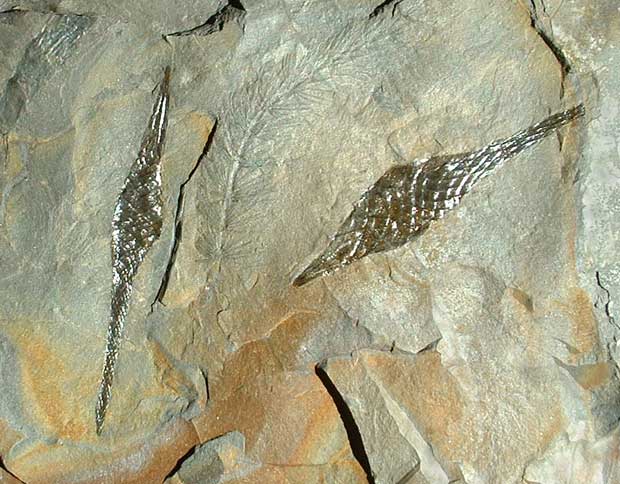
In the first descriptions of the 19th century fossil egg capsules were misinterpreted as cone-like fructifications of some kind of plant. This was due to the rhomboidal pattern the egg capsule impressions often display as consequence of taphonomic flattening (and the consequent overlap of the spiral patterns on the front and back sides). Two types of shark egg capsules have been recovered from the Madygen Formation during fieldwork in 2007 (Fischer et al. 2007) - more on that later.
-----
Jan Fischer, featured in the last FPhotW, who is working on the Madygen chrondrichthyans (as soon as they appear) and isotope paleontology of shark teeth/spines, is thanked here for supplying me with literature. (Hopefully I can convince Jan to write a guest contribution).
Refs:
Synoptical papers:
Maisey, J.G. (1982): The Anatomy and Interrelationships of Mesozoic Hybodont Sharks. - American Museum Novitates 2724: 1- 48; New York.
Schneider, J. W. & Zajic, J. (1994): [Xenacanths (Pisces, Chondrichthyes) of the middle European Upper Carboniferous and Permian - revision of the originals of GOLDFUSS 1847, BEYRICH 1848, KNER 1867 and FRITSCH 1879-1890.] - Freiberger Forschungshefte, C 452: 101-151; Leipzig.
On tooth systematics:
Schneider, J.W. (1988): [Basics of the morphogeny, taxonomy, and biostratigraphy of isolated xenacanth teeth (Elasmobranchii)]. - Freiberger Forschungshefte, C 419: 71- 80; Leipzig.
Rees (2008): Interrelationships of Mesozoic hybodont sharks as
indicated by dental morphology – preliminary results. - Acta Geologica Polonica 58 (2): 217-221.
On egg capsules:
Schneider, J.W. & Reichel, W. (1989): [Chondrichthyan egg capsules from the Rotliegend (Lower Permian) of Middle Europe - conclusions regarding the palaeobiogeography of palaeozoic freshwater sharks.] - Freiberger Forschungshefte, C 436: 58- 69; Leipzig.
Fischer, J., Voigt, S. & Buchwitz, M. (2007):
First elasmobranch egg capsules from freshwater lake deposits of the Madygen Formation (Middle to Late Triassic, Kyrgyzstan, Central Asia). - Paläontologie, Stratigraphie, Fazies (15), Freiberger Forschungshefte, C 524: 41-46; Freiberg.
Complete shark specimens are seldom recorded, the same is true for complex finds comprising a couple of skeletal elements from the same individual - taxonomists often have to deal with assemblages of individual scales, spines, and teeth and systematics heavily relies on tooth characteristics (e.g. Schneider 1988 for the Xenacanthida, Rees 2008 for hybodont sharks).
Like the recent bullhead sharks (Heterodontus) at least some of the Carboniferous to Triassic freshwater sharks were oviparous - different types of spiral egg capsules not quite unlike those capsules of Heterodontus occur in different types of freshwater environments, e.g. marginal lake sediments or low-energy river banks; often they appear unrelated to skeletal remains. This has been interpreted as being indicative for a separation between the actual habitats of the sharks and their spawning grounds (about the facial aspects: see Schneider & Reichel 1989). To what extent the occurrence of xenacanth and hybodont sharks in freshwater deposits is indicative for a marine influence is currently a matter of debate.
In the first descriptions of the 19th century fossil egg capsules were misinterpreted as cone-like fructifications of some kind of plant. This was due to the rhomboidal pattern the egg capsule impressions often display as consequence of taphonomic flattening (and the consequent overlap of the spiral patterns on the front and back sides). Two types of shark egg capsules have been recovered from the Madygen Formation during fieldwork in 2007 (Fischer et al. 2007) - more on that later.
-----
Jan Fischer, featured in the last FPhotW, who is working on the Madygen chrondrichthyans (as soon as they appear) and isotope paleontology of shark teeth/spines, is thanked here for supplying me with literature. (Hopefully I can convince Jan to write a guest contribution).
Refs:
Synoptical papers:
Maisey, J.G. (1982): The Anatomy and Interrelationships of Mesozoic Hybodont Sharks. - American Museum Novitates 2724: 1- 48; New York.
Schneider, J. W. & Zajic, J. (1994): [Xenacanths (Pisces, Chondrichthyes) of the middle European Upper Carboniferous and Permian - revision of the originals of GOLDFUSS 1847, BEYRICH 1848, KNER 1867 and FRITSCH 1879-1890.] - Freiberger Forschungshefte, C 452: 101-151; Leipzig.
On tooth systematics:
Schneider, J.W. (1988): [Basics of the morphogeny, taxonomy, and biostratigraphy of isolated xenacanth teeth (Elasmobranchii)]. - Freiberger Forschungshefte, C 419: 71- 80; Leipzig.
Rees (2008): Interrelationships of Mesozoic hybodont sharks as
indicated by dental morphology – preliminary results. - Acta Geologica Polonica 58 (2): 217-221.
On egg capsules:
Schneider, J.W. & Reichel, W. (1989): [Chondrichthyan egg capsules from the Rotliegend (Lower Permian) of Middle Europe - conclusions regarding the palaeobiogeography of palaeozoic freshwater sharks.] - Freiberger Forschungshefte, C 436: 58- 69; Leipzig.
Fischer, J., Voigt, S. & Buchwitz, M. (2007):
First elasmobranch egg capsules from freshwater lake deposits of the Madygen Formation (Middle to Late Triassic, Kyrgyzstan, Central Asia). - Paläontologie, Stratigraphie, Fazies (15), Freiberger Forschungshefte, C 524: 41-46; Freiberg.
Labels:
Madygen 2007,
review,
triassic critters
Samstag, 3. Januar 2009
Tectonics & Paleo (4):
The world of CPOs and ODFs
Materials in geoscience and biology are often not isotropic - their properties, such as conductivity, soundwave velocity, and shear strength, vary with direction.
The reason can be that they are crystalline - if so, the orientation of the crystal lettice of (one, a few, or) many individual crystal grains has an influence on the properties of the compound material. The individual crystal lettice orientations can be at random or their can be a preferred orientation.
A whole branch of mineralogy and material science deals with the analysis of materials which show crystal preferred orientations (CPOs).
The so-called Orientation Distribution Density Function (ODF) describes how the crystal axes of mineral grains in a sample are oriented relative to an outer coordinate system (e.g. geographic XYZ coordinates). From the ODF, usely depicted as a couple of stereographic density plots (e.g. plots for the crystal a-axis, b-axis and c-axis orientations) the direction and sense of shearing of a rock can be inferred.
Crystal orientations in mineralized tissue are, of course, not defined relative to a geographic coordinate system but to the anatomic directions (or the axis of accretionary growth) of the animal as a reference system.
Coming from the tectonical side I was participating in a workshop on "Textures & Microstructures in Geosciences" in 2005: I was really surprised that there is an application of texture analysis in palaeontology and that some people are really doing it.
U-stage and EBSD are involving single grain measurements of a thin section: For each grain in a certain raster the individual crystal orientation is determined - either by its optical properties using the universal stage (this old-fashioned manual method is rather time-consuming) or by the way how electrons from an electron microbeam are backscattered on a detection screen (Electron Backscatter Diffraction, EBSD). The detected Kikuchi line patterns are indicative for how an individual crystal is oriented (they can be interpreted automatically). What you get in both approaches is not only an ODF but also a crystal orientation map of your thin section.
XRD, Neutron Diffraction. In these methods an X-ray or neutron beam is used to measure a larger volume of a sample comprising several crystals, thereby neutron radiation can penetrate even larger samples completely while the X-ray has a relatively low depth of penetration. From the detected line sprectra pole figures, representing the distributions of certain crystal lettice plane orientations can be derived (from which in turn the ODF of all the crystals in the measured sample volume can be deduced).
The authors employ X-ray diffraction measurements and demonstrate thate the microstructures and crystallographic textures of aragonite layers of species from different mollusc taxa including bivalves, cephalopods, gastropods and monoplacophorans are highly specific and contain a phylogenetic signal: closer relatives are more similar in their shell's crystal orientations.
Pyzalla, A.R., Sander, P.M., Hansen, A., Ferreyo, R., Yi, S.-B., Stempniewicz, M. & Brokmeier, H.-G. (2006): Texture analysis of Sauropod bones from Tendaguru. - Material Science and Engineering A 437: 2-9.
This neutron diffraction approach addresses the question whether the apatite crystallite textures in adolescent and adult Brachiosaurus long bones show some signal indicative for specialized crystal orientations which can be attributed to the giant growth of sauropod dinosaurs. However, comparing their results to the measurements of turkey and other dinosaur long bones they found no significant difference in texture strength or in the predominant direction of fibres.
The reason can be that they are crystalline - if so, the orientation of the crystal lettice of (one, a few, or) many individual crystal grains has an influence on the properties of the compound material. The individual crystal lettice orientations can be at random or their can be a preferred orientation.
A whole branch of mineralogy and material science deals with the analysis of materials which show crystal preferred orientations (CPOs).
From Tectonics...
Structural geologists, who are dealing with microscopic phenomena of tectonic deformation, use mineral textures of rocks, i.e. crystal preferred orientations of the rockforming minerals, as indicators of tectonic movement and deformational regimes (temperature, pressure conditions; deformation rate).The so-called Orientation Distribution Density Function (ODF) describes how the crystal axes of mineral grains in a sample are oriented relative to an outer coordinate system (e.g. geographic XYZ coordinates). From the ODF, usely depicted as a couple of stereographic density plots (e.g. plots for the crystal a-axis, b-axis and c-axis orientations) the direction and sense of shearing of a rock can be inferred.
...to Paleontology
Not only tectonic forces are governing the crystalline properties of natural materials. In a similiar way the (often monomineralic) mineralized tissues of organisms are underlying specific biological formation conditions - the different layers of a skeleton can show rather perfect CPOs.Crystal orientations in mineralized tissue are, of course, not defined relative to a geographic coordinate system but to the anatomic directions (or the axis of accretionary growth) of the animal as a reference system.
Coming from the tectonical side I was participating in a workshop on "Textures & Microstructures in Geosciences" in 2005: I was really surprised that there is an application of texture analysis in palaeontology and that some people are really doing it.
Methodology
You can do either single grain measurements or methods integrating all orientations of crystal grains in a certain volume of the sample.U-stage and EBSD are involving single grain measurements of a thin section: For each grain in a certain raster the individual crystal orientation is determined - either by its optical properties using the universal stage (this old-fashioned manual method is rather time-consuming) or by the way how electrons from an electron microbeam are backscattered on a detection screen (Electron Backscatter Diffraction, EBSD). The detected Kikuchi line patterns are indicative for how an individual crystal is oriented (they can be interpreted automatically). What you get in both approaches is not only an ODF but also a crystal orientation map of your thin section.
XRD, Neutron Diffraction. In these methods an X-ray or neutron beam is used to measure a larger volume of a sample comprising several crystals, thereby neutron radiation can penetrate even larger samples completely while the X-ray has a relatively low depth of penetration. From the detected line sprectra pole figures, representing the distributions of certain crystal lettice plane orientations can be derived (from which in turn the ODF of all the crystals in the measured sample volume can be deduced).
Examples from Paleontology
Chateigner, D., Hedegaard, C. & Wenk, H.-R. (2000): Mollusc shell microstructures and crystallographic textures. - Journal of Structural Geology 22: 1723-1735.The authors employ X-ray diffraction measurements and demonstrate thate the microstructures and crystallographic textures of aragonite layers of species from different mollusc taxa including bivalves, cephalopods, gastropods and monoplacophorans are highly specific and contain a phylogenetic signal: closer relatives are more similar in their shell's crystal orientations.
Pyzalla, A.R., Sander, P.M., Hansen, A., Ferreyo, R., Yi, S.-B., Stempniewicz, M. & Brokmeier, H.-G. (2006): Texture analysis of Sauropod bones from Tendaguru. - Material Science and Engineering A 437: 2-9.
This neutron diffraction approach addresses the question whether the apatite crystallite textures in adolescent and adult Brachiosaurus long bones show some signal indicative for specialized crystal orientations which can be attributed to the giant growth of sauropod dinosaurs. However, comparing their results to the measurements of turkey and other dinosaur long bones they found no significant difference in texture strength or in the predominant direction of fibres.
Prospects
Given the elaborateness of most approaches, measurements of crystallographic textures are rarely used in paleontology - I suppose this will change if it turns out that the analysis of the crystal orientations can provide substantial information which is not obtained from the usual analysis of skeletal histology and microstructures.Samstag, 15. November 2008
Triassic critters: Kazacharthrans
Kazacharthrans - or Katzen, as we call them (jokingly) in German - are an endemic group of small branchiopod crustaceans which were named after the former Soviet Republic of Kazakhstan, where the type locality is situated. All yet known occurrences are restricted to the Middle Triassic to Lower Jurassic of Central Asia (Kazakhstan, Mongolia, Turkmenistan, the northwestern Chinese Province Xinjiang, and Kyrgyzstan: the Madygen Formation).
The closest recent relatives of kazacharthrans and an anatomically quite similar group are the tadpole shrimps (Notostraca), including the 'living fossil' species Triops cancriformis, which has not changed since its earliest occurrence in the Triassic.
Kazacharthran head shield from Madygen; width: 1.2 cm.
The most complete body fossils from Madygen consist of a relatively large cephalothoracic shield (see pic) and a segmented tail with a small and spiny shield at the end (telson). Madygen finds show the head shield often considerably deformed. As the animals were subject to moulting, the abundancy of kazachthran body fossils is raised by the preservation of exuviae.
The riddle of kazachrathran radiation. Kazacharthrans are regarded as a Triassic offspring from the lineage of the otherwise conservative group of notostracans which have persisted since the Carboniferous without larger anatomical changes. As the Kazacharthra develop a relatively high diversity (14 genera, >20 species described) in a narrow spatial and temporal window, the crucial questions is, what their speciality (and fate) was.
Sebastian Voigt (who is in charge of the Madygen project here in Freiberg) is a paleoichnologist and also working on kazacharthran trace fossils and their ethological and ecological implications (see ref below), using the ichnia of recent triopsids for comparison (the reminiscence of a childhood dream to have those lovely trackmakers in your aquarium). Understanding the palaeoenvironment and fossil association of kazachathran body and trace fossils in the Madygen Fm will hopefully help to understand the peculiarity of "Katzen".
Refs:
Chen P., K.G. McKennzie & Zhou, H.(1996): A further research into Late Triassic Kazacharthra from Xinjiang Uigur autonomous region, NW China. - Acta Palaeontologica Sinica 35(3): 272-301.
Preliminary results on Madygen kazacharthrans can be found in the abstract volume of the 2007 fall meeting of the German Palaeontological Society (pdf, 33MB):
Voigt, S.(2007): Kazachartran body and trace fossils from shallow lake deposits of the Madygen Formation (Middle to Upper Triassic, Kyrgyzstan, Central Asia). In: O. Elicki & J.W. Schneider (eds): Fossile Ökosysteme. - Wissenschaftliche Mitteilungen 36, Institut für Geologie, TU Freiberg, p. 160
The closest recent relatives of kazacharthrans and an anatomically quite similar group are the tadpole shrimps (Notostraca), including the 'living fossil' species Triops cancriformis, which has not changed since its earliest occurrence in the Triassic.
Kazacharthran head shield from Madygen; width: 1.2 cm.The most complete body fossils from Madygen consist of a relatively large cephalothoracic shield (see pic) and a segmented tail with a small and spiny shield at the end (telson). Madygen finds show the head shield often considerably deformed. As the animals were subject to moulting, the abundancy of kazachthran body fossils is raised by the preservation of exuviae.
The riddle of kazachrathran radiation. Kazacharthrans are regarded as a Triassic offspring from the lineage of the otherwise conservative group of notostracans which have persisted since the Carboniferous without larger anatomical changes. As the Kazacharthra develop a relatively high diversity (14 genera, >20 species described) in a narrow spatial and temporal window, the crucial questions is, what their speciality (and fate) was.
Sebastian Voigt (who is in charge of the Madygen project here in Freiberg) is a paleoichnologist and also working on kazacharthran trace fossils and their ethological and ecological implications (see ref below), using the ichnia of recent triopsids for comparison (the reminiscence of a childhood dream to have those lovely trackmakers in your aquarium). Understanding the palaeoenvironment and fossil association of kazachathran body and trace fossils in the Madygen Fm will hopefully help to understand the peculiarity of "Katzen".
Refs:
Chen P., K.G. McKennzie & Zhou, H.(1996): A further research into Late Triassic Kazacharthra from Xinjiang Uigur autonomous region, NW China. - Acta Palaeontologica Sinica 35(3): 272-301.
Preliminary results on Madygen kazacharthrans can be found in the abstract volume of the 2007 fall meeting of the German Palaeontological Society (pdf, 33MB):
Voigt, S.(2007): Kazachartran body and trace fossils from shallow lake deposits of the Madygen Formation (Middle to Upper Triassic, Kyrgyzstan, Central Asia). In: O. Elicki & J.W. Schneider (eds): Fossile Ökosysteme. - Wissenschaftliche Mitteilungen 36, Institut für Geologie, TU Freiberg, p. 160
Mittwoch, 29. Oktober 2008
Wing types, Sharovipteryx, Longi
In his review on wing evolution Dietrich Schaller (1985) distinguished wing types according to function, type of wing attachment, and type of airfoil support.
Accordingly there are 'limb wings' and wings not involving limbs. The latter ones can be jointless, such as the pleural wings of Draco and kuehneosaurids, or single-jointed, such as the chitinous wings of insect flapping fliers.
What about the "enigmatic" Madygen beasts?
Sharovipteryx was an early limb-wing glider. Depending on the interpretation of wing topology it is reconstructed either with the fore- and hindlimbs connected by a wing membrane - representing the type of a 'skelobrachial glider' (sensu Schaller) - or with separate brachial (arm) wings and skelosal (leg) wings.
The latter case is discussed in particular by Dyke et al. (2006): Their modelling of the aerodynamic properties of different Sharovipteryx wing configurations demonstrates that a double delta wing morphology would have been the most advantageous for gliding (using certain input conditions based on model assumptions derived from the study of the morphology of the only fossil specimen).
Longisquama as a two-wing glider is not classified as easily. It would possess multi-segment and muli-jointed gliding wings which would constitute airfoils without further structures for support. Schaller did not consider such a configuration. Or else, it would have jointless wings comparable to the membranous muscle-supported flank wings of the gliding gecko Ptychozoon - but with the difference of being segmented, attached to the back and several times as long (minor drawbacks?).
References:
Schaller, D. (1985): Wing Evolution. In: Hecht, M.K., J.H. Ostrom, G. Viohl & P. Wellnhofer: The beginnings of birds. - Eichstätt (Freunde des Juramuseums), pp. 333- 348.
Dyke, G.J., R.L. Nudds & J.M.V. Rayner (2006): Flight of Sharovipteryx mirabilis: the world's first delta-winged glider. - Journal of Evolutionary Biology 19(4): 1040-1043.
Accordingly there are 'limb wings' and wings not involving limbs. The latter ones can be jointless, such as the pleural wings of Draco and kuehneosaurids, or single-jointed, such as the chitinous wings of insect flapping fliers.
What about the "enigmatic" Madygen beasts?
Sharovipteryx was an early limb-wing glider. Depending on the interpretation of wing topology it is reconstructed either with the fore- and hindlimbs connected by a wing membrane - representing the type of a 'skelobrachial glider' (sensu Schaller) - or with separate brachial (arm) wings and skelosal (leg) wings.
The latter case is discussed in particular by Dyke et al. (2006): Their modelling of the aerodynamic properties of different Sharovipteryx wing configurations demonstrates that a double delta wing morphology would have been the most advantageous for gliding (using certain input conditions based on model assumptions derived from the study of the morphology of the only fossil specimen).
Longisquama as a two-wing glider is not classified as easily. It would possess multi-segment and muli-jointed gliding wings which would constitute airfoils without further structures for support. Schaller did not consider such a configuration. Or else, it would have jointless wings comparable to the membranous muscle-supported flank wings of the gliding gecko Ptychozoon - but with the difference of being segmented, attached to the back and several times as long (minor drawbacks?).
References:
Schaller, D. (1985): Wing Evolution. In: Hecht, M.K., J.H. Ostrom, G. Viohl & P. Wellnhofer: The beginnings of birds. - Eichstätt (Freunde des Juramuseums), pp. 333- 348.
Dyke, G.J., R.L. Nudds & J.M.V. Rayner (2006): Flight of Sharovipteryx mirabilis: the world's first delta-winged glider. - Journal of Evolutionary Biology 19(4): 1040-1043.
Mittwoch, 15. Oktober 2008
Triassic critters: Titanopterans
Among the most remarkable fossil insects from Madygen are the titanopterans which can reach wing spans of 50 cm. The Titanoptera form a subgroup of the Neoptera and were usually regarded as having an order rank when the Linnean taxonomic system is applied. Recently, there was a revision done by Olivier Béthoux, who is currently working as a Humboldt research fellow at the geological institute of my alma mater (actually he is my "bureau mate"):
Béthoux (2007): Cladotypic taxonomy applied: Titanopterans are Orthopterans. - Arthropod Systematics & Phylogeny 65(2): 135- 156.
Recent orthopterans include grasshoppers and crickets. Olivier Béthoux shows on the basis of wing venation topology that members of a Permian "family" of Orthoptera - the Tcholmanvissiidae - are the closest relatives of the Triassic group Titanoptera. Such a relationship was also proposed by Madygen researcher A. G. Sharov as early as 1968 but later doubted by others.
The 'Titanopterida' are newly defined as a subgroup of the 'Tcholmantitanopterida' which are in turn a subgroup of Tcholmanvissiidae:
"Species that evolved from the (segments of) metapopulation lineage in which the character state ‘in forewing, CuPaα• + CuPaβ and CuPb having the same point of origin’, as exhibited by giganteus Tillyard, 1916 and vulgaris Sharov, 1968, has been acquired." (see page 145)
The cryptic formulas refer to higher order branches of the posterior Cubitus (CuP), a main wing veine.
Olivier's paper is interesting for another reason: As announced in the title he uses the relationship of titanopterans as an example for applying his concept of cladotypic taxonomy which on its own may be worth a post here (after I got the point). One part of his idea may be frightening for some biologists - as in the definition above there is no longer a need for binary nomenclature.
Abonnieren
Kommentare (Atom)