Posts mit dem Label Madygen 2007 werden angezeigt. Alle Posts anzeigen
Donnerstag, 28. Oktober 2010
Madygenerpeton pustulatus: first description finally out
Schoch, R. R., S. Voigt, and M. Buchwitz. 2010. A chroniosuchid from the Triassic of Kyrgyzstan and analysis of chroniosuchian relationships. Zoological Journal of the Linnean Society 160(3): 515-530. [Abstract]
Labels:
bone,
evolution,
Madygen 2007,
News,
phylogenetics,
tetrapods,
triassic critters
Freitag, 23. Januar 2009
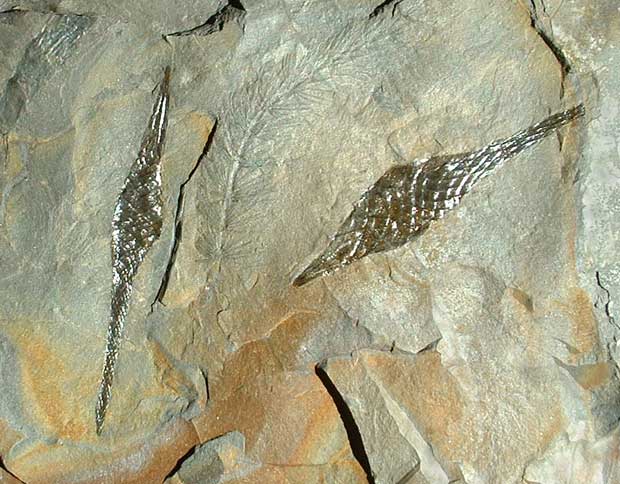
Triassic critters: Freshwater sharks
Lakes and rivers of the younger Paleozoic and as well in the Triassic could not only house tetrapod and bony fish vertebrate dwellers but also selachian predators, in particular the Xenacanthida, well known for their characteristic neck spines, and the Hybodontiformes, which display a pair of lateral head spines and characteristic fin spines. The latter are distinct from those of the Acanthodii (popularly also referred to as "spiny sharks"), a group of basal vertebrates that ocurred in freshwater environments as well, but became extinct before the beginning of the Triassic.
Complete shark specimens are seldom recorded, the same is true for complex finds comprising a couple of skeletal elements from the same individual - taxonomists often have to deal with assemblages of individual scales, spines, and teeth and systematics heavily relies on tooth characteristics (e.g. Schneider 1988 for the Xenacanthida, Rees 2008 for hybodont sharks).
Like the recent bullhead sharks (Heterodontus) at least some of the Carboniferous to Triassic freshwater sharks were oviparous - different types of spiral egg capsules not quite unlike those capsules of Heterodontus occur in different types of freshwater environments, e.g. marginal lake sediments or low-energy river banks; often they appear unrelated to skeletal remains. This has been interpreted as being indicative for a separation between the actual habitats of the sharks and their spawning grounds (about the facial aspects: see Schneider & Reichel 1989). To what extent the occurrence of xenacanth and hybodont sharks in freshwater deposits is indicative for a marine influence is currently a matter of debate.
In the first descriptions of the 19th century fossil egg capsules were misinterpreted as cone-like fructifications of some kind of plant. This was due to the rhomboidal pattern the egg capsule impressions often display as consequence of taphonomic flattening (and the consequent overlap of the spiral patterns on the front and back sides). Two types of shark egg capsules have been recovered from the Madygen Formation during fieldwork in 2007 (Fischer et al. 2007) - more on that later.
-----
Jan Fischer, featured in the last FPhotW, who is working on the Madygen chrondrichthyans (as soon as they appear) and isotope paleontology of shark teeth/spines, is thanked here for supplying me with literature. (Hopefully I can convince Jan to write a guest contribution).
Refs:
Synoptical papers:
Maisey, J.G. (1982): The Anatomy and Interrelationships of Mesozoic Hybodont Sharks. - American Museum Novitates 2724: 1- 48; New York.
Schneider, J. W. & Zajic, J. (1994): [Xenacanths (Pisces, Chondrichthyes) of the middle European Upper Carboniferous and Permian - revision of the originals of GOLDFUSS 1847, BEYRICH 1848, KNER 1867 and FRITSCH 1879-1890.] - Freiberger Forschungshefte, C 452: 101-151; Leipzig.
On tooth systematics:
Schneider, J.W. (1988): [Basics of the morphogeny, taxonomy, and biostratigraphy of isolated xenacanth teeth (Elasmobranchii)]. - Freiberger Forschungshefte, C 419: 71- 80; Leipzig.
Rees (2008): Interrelationships of Mesozoic hybodont sharks as
indicated by dental morphology – preliminary results. - Acta Geologica Polonica 58 (2): 217-221.
On egg capsules:
Schneider, J.W. & Reichel, W. (1989): [Chondrichthyan egg capsules from the Rotliegend (Lower Permian) of Middle Europe - conclusions regarding the palaeobiogeography of palaeozoic freshwater sharks.] - Freiberger Forschungshefte, C 436: 58- 69; Leipzig.
Fischer, J., Voigt, S. & Buchwitz, M. (2007):
First elasmobranch egg capsules from freshwater lake deposits of the Madygen Formation (Middle to Late Triassic, Kyrgyzstan, Central Asia). - Paläontologie, Stratigraphie, Fazies (15), Freiberger Forschungshefte, C 524: 41-46; Freiberg.
Complete shark specimens are seldom recorded, the same is true for complex finds comprising a couple of skeletal elements from the same individual - taxonomists often have to deal with assemblages of individual scales, spines, and teeth and systematics heavily relies on tooth characteristics (e.g. Schneider 1988 for the Xenacanthida, Rees 2008 for hybodont sharks).
Like the recent bullhead sharks (Heterodontus) at least some of the Carboniferous to Triassic freshwater sharks were oviparous - different types of spiral egg capsules not quite unlike those capsules of Heterodontus occur in different types of freshwater environments, e.g. marginal lake sediments or low-energy river banks; often they appear unrelated to skeletal remains. This has been interpreted as being indicative for a separation between the actual habitats of the sharks and their spawning grounds (about the facial aspects: see Schneider & Reichel 1989). To what extent the occurrence of xenacanth and hybodont sharks in freshwater deposits is indicative for a marine influence is currently a matter of debate.
In the first descriptions of the 19th century fossil egg capsules were misinterpreted as cone-like fructifications of some kind of plant. This was due to the rhomboidal pattern the egg capsule impressions often display as consequence of taphonomic flattening (and the consequent overlap of the spiral patterns on the front and back sides). Two types of shark egg capsules have been recovered from the Madygen Formation during fieldwork in 2007 (Fischer et al. 2007) - more on that later.
-----
Jan Fischer, featured in the last FPhotW, who is working on the Madygen chrondrichthyans (as soon as they appear) and isotope paleontology of shark teeth/spines, is thanked here for supplying me with literature. (Hopefully I can convince Jan to write a guest contribution).
Refs:
Synoptical papers:
Maisey, J.G. (1982): The Anatomy and Interrelationships of Mesozoic Hybodont Sharks. - American Museum Novitates 2724: 1- 48; New York.
Schneider, J. W. & Zajic, J. (1994): [Xenacanths (Pisces, Chondrichthyes) of the middle European Upper Carboniferous and Permian - revision of the originals of GOLDFUSS 1847, BEYRICH 1848, KNER 1867 and FRITSCH 1879-1890.] - Freiberger Forschungshefte, C 452: 101-151; Leipzig.
On tooth systematics:
Schneider, J.W. (1988): [Basics of the morphogeny, taxonomy, and biostratigraphy of isolated xenacanth teeth (Elasmobranchii)]. - Freiberger Forschungshefte, C 419: 71- 80; Leipzig.
Rees (2008): Interrelationships of Mesozoic hybodont sharks as
indicated by dental morphology – preliminary results. - Acta Geologica Polonica 58 (2): 217-221.
On egg capsules:
Schneider, J.W. & Reichel, W. (1989): [Chondrichthyan egg capsules from the Rotliegend (Lower Permian) of Middle Europe - conclusions regarding the palaeobiogeography of palaeozoic freshwater sharks.] - Freiberger Forschungshefte, C 436: 58- 69; Leipzig.
Fischer, J., Voigt, S. & Buchwitz, M. (2007):
First elasmobranch egg capsules from freshwater lake deposits of the Madygen Formation (Middle to Late Triassic, Kyrgyzstan, Central Asia). - Paläontologie, Stratigraphie, Fazies (15), Freiberger Forschungshefte, C 524: 41-46; Freiberg.
Labels:
Madygen 2007,
review,
triassic critters
Montag, 8. Dezember 2008
Fieldwork Photo of the Week
Northern Alay Chain, Batken District, SW Kyrgyzstan.Standing on massive Devonian limestones we are looking to the NNW. On the right you can see the greenish Madygen river oasis bearing a few farms and fruit plantations. On the left: the badlands represent the SW outcrop area of the Triassic Madygen Formation.
To the north and northwest reddish strata and ribs of Cretaceous conglomerate follow which overlie a narrow stripe of Jurassic. Than there is a succession of mostly Cenozoic rocks forming the core of a syncline.
In the distance you can see larger massifs of mostly Paleozoic schists, limestones and conglomerates. And then there is the greenish plain to the northwest marking another outcrop of fineclastic sediments.
This is Dzhaylyau-Cho ("good meadow"), the NW outcrop area of the Madygen Fm, including "Sharov Quarry" as the most famous locality for insects and tetrapods.

Can you see the artificial band-like wall to the west of the Madygen oasis - this is some relic from ancient times (built under Alexander the Great according to a myth).
Dienstag, 25. November 2008
Fieldwork Photo of the Weak
The Neverending Outcrop: Younger stratigraphic succession near Madygen, SW Kyrgyzstan.
The greyish-brownish Madygen Formation is overlayn uncomformably by varicoloured continental Jurassic strata which in turn are separated by an uncomformity from reddish deposits of the facially diverse Cretaceous including massive conglomeratic banks.

Paleogene: A yellowish marine succession containing mass occurrences of oysters and massive carbonates is followed by younger continental deposits of the Tertiary.
Note the roofs of premises belonging to the village of Madygen.
The greyish-brownish Madygen Formation is overlayn uncomformably by varicoloured continental Jurassic strata which in turn are separated by an uncomformity from reddish deposits of the facially diverse Cretaceous including massive conglomeratic banks.Paleogene: A yellowish marine succession containing mass occurrences of oysters and massive carbonates is followed by younger continental deposits of the Tertiary.
Note the roofs of premises belonging to the village of Madygen.
Samstag, 8. November 2008
Fieldwork Photo of the Week
That pile of weathered shale debris we are sitting on is the product of Sharov's group in the 1960s and of our work. The photo is taken from the position of the outcrop wall.
The Sharov locality is the place where all hiherto described Madygen tetrapods, most insects and fishes, and some of the best plant fossils have been found.
Abonnieren
Kommentare (Atom)