Freitag, 13. Februar 2009

Permotriassic entomofaunal change + the Madygen

Dmitry E. Shcherbakov from Moscow is one of the paleobiologists studying the very group of beings for which Madygen really is a lagerstätte: insects.

Some of his 2008 papers in the Moscovian Paleontological Journal and Alavesia, a relatively new journal for fossil insects, can be found as .pdfs on the library page of the International Palaeoentomological Society (IPS).


Shcherbakov, D.E. 2008. Insect recovery after the Permian/Triassic crisis. Alavesia 2: 125-131. [pdf]

Shcherbakov, D.E. 2008. On Permian and Triassic insect faunas in relation to biogeography and the Permian–Triassic crisis. Paleontological Journal 42 (1): 15-31. [pdf]

The Alavesia paper outlines a three phase development of Triassic entomofaunas, beginning with
(I) a low-diversity episod of P/T recovery dominated by Paleozoic insect groups, followed by
(II) a summit phase with typical Triassic taxa in the Anisian-Carnian, and, with a decline in diversity, ending in
(III) a phase dominated by Late Mesozoic elements, especially featuring new aquatic insect groups.
Shcherbakov suggests, that each of the transitions began in the humid low latitudes and occurred later in the higher latitudes, i.e. the boundaries between those three stages are diachronous.

In the Paleontological Journal paper Dmitry Shcherbakov looks at the insect diversity of Late Carboniferous to Triassic localities, counting the proven occurrences of insect families per stage ('stage' as a chronostratigraphic unit). He illustrates the change in aquatic/ terrestrial, phytophages/ predators, modern/ ancient groups and explains the ecological, evolutionary, and biogeographic background of diversity fluctuations.


Shcherbakov, D.E. 2008. Madygen, Triassic Lagerstätte number one, before and after Sharov. Alavesia 2: 113-124.[pdf]

This review paper begins with a recount of the research history of the Madygen Formation as a Triassic fossil locality, beginning with the geological fieldwork in the 1930s (by Kochnev) which led to the first finds of a fossil flora, classified as Triassic, and to the introduction of the Madygen strata as a separate stratigraphic unit.

In detail the role of paleoentomologist Alexander G. Sharov is recognized, who lead five field expeditions between 1962 and 1966 to a fossiliferous point in the northern Madygen outcrop area (Dzhailoucho). These campaigns turned out as the most successful with regard to the number of recovered insect specimens and other fossils. The historical part is followed by a short overview of the flora and non-insect fauna.

The main part is a synopsis of the particular insect fauna of Madygen. Besides the exquisite state of preservation, several figures illustrate why Madygen really is a lagerstätte: Members of twenty insect orders and 96 out of 106 insect families known from the Ladinian/Carnian have been reported from the Madygen Formation.

In this order beetles, cockcroaches, and homopterans represent the most abundant groups. Among rarer groups are certain specialities, such as the most diverse assemblage of titanopterans. Modern insect orders are represented by several groups of early dipterans and the earliest hymenopterans (belonging to the group of sawflies).

Donnerstag, 12. Februar 2009

Ballad

In memory of Charles R. Darwin (1809-1882)

My fish is sad and lonely
Striving for arms to embrace only
O Lamarck, the flesh is weak!
The fins just stay-
Despair 'n' dismay.

See generations later
Arms had but the best wade-through raider.
Fish feelings selection not passed.
They ebbed away-
Despair 'n' dismay.

Nothing but comprehension
Lies in Darwin's more stately mansion
World tells no moral'ty tale.
No more to say-
Despair 'n' dismay.

Montag, 2. Februar 2009

Fieldwork Photo of the Week


In the back you can see a tectonic contact: Massive limestones are thrusted over some less competent schist units and/or Madygen sediments. Thanks to Juliane for that photo.

Freitag, 23. Januar 2009

Triassic critters: Freshwater sharks

Lakes and rivers of the younger Paleozoic and as well in the Triassic could not only house tetrapod and bony fish vertebrate dwellers but also selachian predators, in particular the Xenacanthida, well known for their characteristic neck spines, and the Hybodontiformes, which display a pair of lateral head spines and characteristic fin spines. The latter are distinct from those of the Acanthodii (popularly also referred to as "spiny sharks"), a group of basal vertebrates that ocurred in freshwater environments as well, but became extinct before the beginning of the Triassic.

Complete shark specimens are seldom recorded, the same is true for complex finds comprising a couple of skeletal elements from the same individual - taxonomists often have to deal with assemblages of individual scales, spines, and teeth and systematics heavily relies on tooth characteristics (e.g. Schneider 1988 for the Xenacanthida, Rees 2008 for hybodont sharks).

Like the recent bullhead sharks (Heterodontus) at least some of the Carboniferous to Triassic freshwater sharks were oviparous - different types of spiral egg capsules not quite unlike those capsules of Heterodontus occur in different types of freshwater environments, e.g. marginal lake sediments or low-energy river banks; often they appear unrelated to skeletal remains. This has been interpreted as being indicative for a separation between the actual habitats of the sharks and their spawning grounds (about the facial aspects: see Schneider & Reichel 1989). To what extent the occurrence of xenacanth and hybodont sharks in freshwater deposits is indicative for a marine influence is currently a matter of debate.

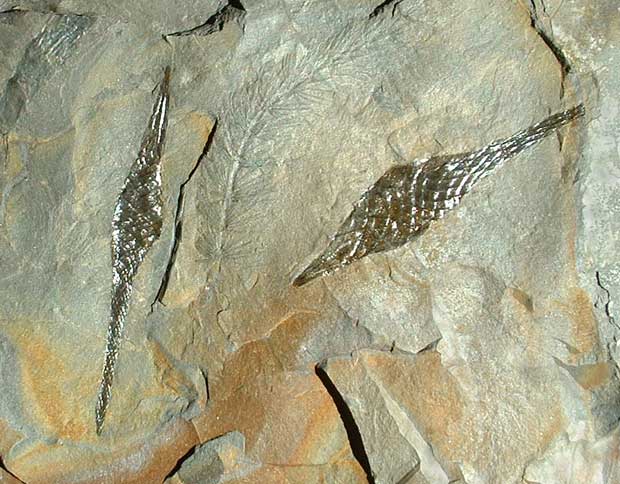
In the first descriptions of the 19th century fossil egg capsules were misinterpreted as cone-like fructifications of some kind of plant. This was due to the rhomboidal pattern the egg capsule impressions often display as consequence of taphonomic flattening (and the consequent overlap of the spiral patterns on the front and back sides). Two types of shark egg capsules have been recovered from the Madygen Formation during fieldwork in 2007 (Fischer et al. 2007) - more on that later.

-----
Jan Fischer, featured in the last FPhotW, who is working on the Madygen chrondrichthyans (as soon as they appear) and isotope paleontology of shark teeth/spines, is thanked here for supplying me with literature. (Hopefully I can convince Jan to write a guest contribution).

Refs:

Synoptical papers:
Maisey, J.G. (1982): The Anatomy and Interrelationships of Mesozoic Hybodont Sharks. - American Museum Novitates 2724: 1- 48; New York.

Schneider, J. W. & Zajic, J. (1994): [Xenacanths (Pisces, Chondrichthyes) of the middle European Upper Carboniferous and Permian - revision of the originals of GOLDFUSS 1847, BEYRICH 1848, KNER 1867 and FRITSCH 1879-1890.] - Freiberger Forschungshefte, C 452: 101-151; Leipzig.


On tooth systematics:
Schneider, J.W. (1988): [Basics of the morphogeny, taxonomy, and biostratigraphy of isolated xenacanth teeth (Elasmobranchii)]. - Freiberger Forschungshefte, C 419: 71- 80; Leipzig.

Rees (2008): Interrelationships of Mesozoic hybodont sharks as
indicated by dental morphology – preliminary results. - Acta Geologica Polonica 58 (2): 217-221.


On egg capsules:
Schneider, J.W. & Reichel, W. (1989): [Chondrichthyan egg capsules from the Rotliegend (Lower Permian) of Middle Europe - conclusions regarding the palaeobiogeography of palaeozoic freshwater sharks.] - Freiberger Forschungshefte, C 436: 58- 69; Leipzig.

Fischer, J., Voigt, S. & Buchwitz, M. (2007):
First elasmobranch egg capsules from freshwater lake deposits of the Madygen Formation (Middle to Late Triassic, Kyrgyzstan, Central Asia). - Paläontologie, Stratigraphie, Fazies (15), Freiberger Forschungshefte, C 524: 41-46; Freiberg.

Mittwoch, 21. Januar 2009

Fieldwork Photo of The Week

Morning time at the digging site: Having contemplated the vast landscape bare of human presence but sprenkled with the litter of a forgotten civilization graduate student Jan Fischer decides on the right moment for starting his daily business of not moving to many a rock at once and feigning the impression of having survived another day in this vale of tears only at the close of livelong fatigue and exhaustion...